Showing posts with label Palestinian Heritage. Show all posts
Showing posts with label Palestinian Heritage. Show all posts
Sunday, May 10, 2026


Saturday, March 15, 2025
Najat El-Taji El-Khairy- She Speaks Through Her Art Preserving Palestine's Cultural Heritage Through the Modern Embodiment of Traditional Palestinian Art
 |
| Najat El-Taji El-Khairy |
https://www.instagram.com/najatpalestine
Since 2004, NAJAT’s artistic mission has been to preserve Palestine’s cultural heritage through the Modern Embodiement of Traditional Palestinian Art.
Pioneering this powerful idea has inspired many others in this shared mission. NAJAT commends this and believes that Together we go Further.

She Speaks Through Her Art
Born in 1948, of Palestinian origin, Najat El-Taji El-Khairy attended a French school in Cairo and completed a BA in English Literature at King Saud University in Riyadh.
Fascinated with art since childhood, she studied music, ballet dancing, painting, embroidery, stained glass, pottery and silk painting - while raising a family of four children with her husband Mazen - born in Jerusalem.
Palestinian embroidery in particular caught her attention. She was captivated by its outstanding floral and geometric designs, so she started collecting village dresses & other embroidered articles. She still owns and exhibits them today with the porcelain art she re-creates from them.
In 1988, Najat moved with her family from Saudi Arabia to Montreal Canada, where she further developed her artistic skills. In particular, she perfected painting on porcelain under the guidance of a Hungarian Master from Herend. Soonafter, NAJAT opened her atelier, Kery Porcelain, specializing in personalized and exclusive gift items for different occasions.
Najat was also a dedicated researcher, lecturer and advocate on Palestinian art and heritage.
As she perfected her porcelain painting skills, in 2003, she developed the idea of merging two of her favorite art forms - Embroidery and Porcelain Painting. In 2004, she began producing stitch-perfect painted replicas of embroidery on porcelain, along with other forms of Palestinian art on porcelain.
This is now her artistic mission in life.
Every piece is unique and original. Najat uses a variety of copyrighted painting techniques developed over her career. Meticulous work with strict attention to detail is critical. After painting, the porcelain undergoes several high temperature kiln firings developed by the artist. In this way, the art is preserved in Najat’s own unique way. Her artwork is displayed in various museums and galleries throughout North America. https://www.najat.ca/about
 |
| Art and installation by Najat El-Taji El-Khairy. |
 |
| Najat El-Taji El-Khairy art in above image closer at Meridian Gallery. |
 |
| Olive Harvest- Forbidden |
"A 1980 law forbidding artwork of "political significance" banned art composed of the four colours of the Palestinian flag, red, green, white and black. Palestinians were arrested for displaying such artwork. The ban was lifted after the signing of the Oslo Accords in 1993.
Palestinian artists would not be allowed to paint a flower field using those colours. Even avoiding the "direct and noticeable" use of the colours, an artist would nevertheless be committing felony. The police would storm the art gallery in the West Bank at the time and storm artists houses and confiscate them."
The forbidden colors are rendering freely these sceneries of the peaceful olive grove. They depict the village women, wearing their beautiful hand embroidred Palestinian costumes, picking the fruits of peace during the festive olive harvest season. Cross stitch motifs, taken from Palestinian patterns and designs, paint the fields and dunes surrounding them, asserting the identity of the land. Motifs like: “The Walls of Jerusalem”, “the Road to Nablus”, “the Old Man’s teeth” and “The Star of Bethlehem” The map of Palestine always hidden in the olive branches asserts its presence on this land.
 |
| Nostalgia by Najat |
An olive grove with its trees bearing the fruits of peace, in harmony with the Palestinian cross stitch embroidery patterns that embellish the women’s village dresses, the flower of Ramla, and the star of Bethlehem are combined to stimulate a nostalgic feeling to our beloved land.
Technique: Hand painting using raised enamel to give each leaf a dignified luminous effect. Pen work is used for the cross stitch patterns. The Porcelain tile is then fired several times to preserve the work.
 |
| Palestinian Existence by Najat |
Najat El-Khairy
@palestinianart
%20%E2%80%A2%20Instagram%20photos%20and%20videos.png) |
| najatpalesti |
Friday, June 23, 2023
Wafa Shami's A is for Arab- a playful romp through the Arab World for all ages
 |


Wafa Shami was born and raised in Ramallah, Palestine. She moved to the U.S. to pursue higher education and graduated with a Master’s degree in International Studies. Since moving to the U.S. Wafa has maintained her engagement in Middle Eastern issues as a volunteer. After her son was born she was inspired to write children’s storybooks based on her childhood memories Her stories, Easter in Ramallah, and Olive Harvest in Palestine were published in the last few years. Besides being busy raising her son. Wafa who lives in California has a passion for cooking and writes a food blog, in which she shares her family’s recipes. Visit her blog at www.palestineinadish.com and follow her on social media @palestineinadish for delicious recipes.
Tuesday, December 28, 2021
Palestine's many Christmases: Faces of diversity in the cradle of Christianity
 |
|
The old city of Bethlehem houses numerous convents, chapels and monasteries of different Christian communities are present [Qassam Muaddi / TNA] |
As always, please go to the original link to read the story in full, and share it if you can so more people might see and think about it.
Palestine's many Christmases: Faces of diversity in the cradle of Christianity: Christmas celebrations in Palestine culminate on December 25. But inside Bethlehem itself, the diversity of Christian traditions translates into different dates of celebration, for different communities.
 |
|
Palestinian Christian families visit the Nativity grotto, believed to be the birthplace of Jesus, seeking blessings for their children [Qassam Muaddi / TNA] |
https://english.alaraby.co.uk/features/palestines-many-christmases-faces-christian-diversity
Thursday, December 16, 2021
UNESCO » Culture » Intangible Heritage » Lists » The art of embroidery in Palestine, practices, skills, knowledge and rituals

The art of embroidery in Palestine, practices, skills, knowledge and rituals
Inscribed in 2021 (16.COM) on the Representative List of the Intangible Cultural Heritage of Humanity
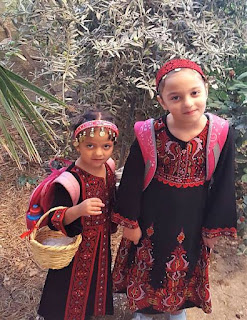
The art of traditional embroidery is widespread in Palestine. Originally made and worn in rural areas, the practice is now common in all of Palestine and among members of the diaspora. Women’s village clothing usually consists of a long dress, trousers, a jacket, a headdress and a veil. Each of these garments is embroidered with a variety of symbols including birds, trees and flowers. The choice of colours and designs indicates the woman’s regional identity and marital and economic status. On the main garment, the loose-fitting dress called a thob, the chest, sleeves and cuffs are covered with embroidery. Embroidered, vertical panels run down the dress from the waist. The embroidery is sewn with silk thread on wool, linen or cotton. Embroidery is a social and intergenerational practice, as women gather in each other’s homes to practise embroidery and sewing, often with their daughters. Many women embroider as a hobby, and some produce and sell embroidered pieces to supplement their family’s income, either on their own or in collaboration with other women. These groups gather in each other’s homes or in community centres, where they may also market their work. The practice is transmitted from mother to daughter and through formal training courses.




Friday, March 1, 2019
Preserved Online For All To See ... a poem by Anne Selden Annab
 |
| “My Christian grandmother and my Muslim grandmother in Palestine” - Shared by a Palestinian man on Facebook |
The Holy Land
You have bullets, bully
brigades,
biblical words &
word smiths
all fundraising for
more...
More injustice. More
suffering.
More homes and gardens
usurped,
more children tormented
and
families destroyed in
what was
(what always will be)
historic Palestine.
We have nothing much
more
than personal stories,
beloved memories,
and old photographs
preserved online for all
to see.
We are people, human
beings.
Our ancestry reaches
back
totally entwined with
every
rock and stone, every
tree,
every water well, every
little flower,
no matter where we are
now.
Our recipes are of the
land
and trade routes, plus
trial
and error. We
helped perfect bread
baked in clay ovens, in
our own way.
Our Zaatar is a
scrumptious blend
of herbs & our olive
oil is heavenly gold.
We keep keys.
Our embroideries are
by hand, with symbols
imagined and taught
mother to daughter for
eons,
for longer than thread can last.
Our hope is that one day
justice and peace will
prevail
for all good people
willing to
actively empower fair
and just laws
with full and equal
rights, respect,
dignity... and security for
all.
poem
copyright ©2015 Anne Selden Annab
-->
Sunday, January 6, 2019
"The world will never be broken, because we will always stitch it back together & make it beautiful." Susan Muaddi Darraj: #tweetyourthobe
 |
2019 #TweetYourThobe creator Susan Muaddi Darraj |

 |
Codebreaker! From the initiator of the marvelous #TweetYourThobe Twitter/Facebook campaign, Susan Muaddi Darraj:
"Wondering what all the symbols mean on Palestinian thobes? The 2nd half of Leila ElKhalidi's book has a "dictionary"!..."
|
 |
| Susan Muaddi Darraj, author of A Curious Land & The Inheritance of Exile |
#TweetYourThobe. "I was raised in a Palestinian-American family that
celebrated the strength of women," Darraj told the Institute of Middle
Eastern Understanding. "Seeing Rashida Tlaib wear her thobe today is a
powerful affirmation of that strength. I started #TweetYourThobe to
celebrate her achievement and educate our fellow Americans about our
culture."
~~~~~~~~~~~~~~~~~~~~~~~~~~~~~~~~~~~~
Tatreez & Tea & Rashida Tlaib & #TweetYourThobe : "Today... she was all of us"
 |
| Wafa Ghnaim: "I was interviewed by the New York Times today to discuss the significance in the first Palestinian-American congresswoman @rashidatlaib wearing a traditional Palestinian thobe to her swearing in ceremony today. Palestinian women and their artistry have long been invisible in history and today our maternal ancestors were seen in the halls of Western power. Rashida’s decision to wear her thobe to a significant moment in her life is one Palestinian women naturally think to do for any momentous achievements in career, life and family. Today, Rashida’s thobe stood for all Palestinian women. She was all of us." |
~~~~~~~~~~~~~~~~~~~~~~~~~~~~~~~~
IN HONOR OF RASHIDA TLAIB #TweetYourThobe ...Beautiful Palestinian Christian Women from Bethlehem, Palestine
Palestinian traditional costumes infographic map #America #TweetYourThobe #Heritage #Beauty #Palestine #History
Spring in Palestine by Ismail Shammout #TweetYourThobe

~~~~~~~~~~~~~~~~~~~~~~~~~~~~~~~~~
Putting a Face on the Facts... An Easy to Understand Essay by Nancy Harb Almendras outlining a Global Controversy: The conflict between the state of Israel and the Palestinians.
A Christmas poem... Star Street Bethlehem Palestine 2014
Ibrahim's Estate .... a poem by Anne Selden Annab
The Promised Land: In Celebration of the Universal Declaration of Human Rights
& Peace Day
& Peace Day
Little Golden Bell... a poem by Anne Selden Annab
 Tiny 2,000-year-old golden bell found in Jerusalem: A
tiny golden bell which was lost in Jerusalem some 2,000 years ago
during the Second Temple period has been found among ruins near the Old
City, Israel's Antiquities Authority has said
Tiny 2,000-year-old golden bell found in Jerusalem: A
tiny golden bell which was lost in Jerusalem some 2,000 years ago
during the Second Temple period has been found among ruins near the Old
City, Israel's Antiquities Authority has saidAsk a Name... a poem by Anne Selden Annab
...Universal Echo
Embroidered keepsakes (2008)
And so in growing a private personal garden for Palestine today, I think it is important to spend some time exploring and enjoying treasures that can be found on the Internet. Capturing ideas and colors and shapes that can be used in our gardens."
Planning a garden is one step towards planting it and making it real:

Growing Gardens for Palestine
The Golden Rule... Do unto others as you would have them do unto you
"WHEREAS recognition of the inherent dignity
and of the equal and inalienable rights of all members of the human
family is the foundation of freedom, justice and peace in the world..." Universal Declaration of Human Rights, 1948

Subscribe to:
Posts (Atom)
Aunt Jameela's Bread. A Story of Food, Family, and Love..... A beautiful new book by Palestinian-American Mike Odetalla about childhood and baking bread in his homeland.
A beautiful new book by Palestinian-American Mike Odetalla about childhood, family, and homemade bread in his homeland ...

-
 Today I was delighted today to find a comment from another blogger who loves both gardens and Palestine. A lajnabiya ! http://alajnabiya.bl...
 -
 We went to the Garden Center late this summer's morning. It's a very pleasant way to spend time- so much beauty and grace and potent...